
Awaab’s Law represents the most significant legislative change in social housing regulation for decades, establishing stringent legal requirements for damp and mould management that fundamentally alter operational obligations for social housing providers whilst setting new standards for tenant health protection across the sector.
The Legislative Foundation and Background
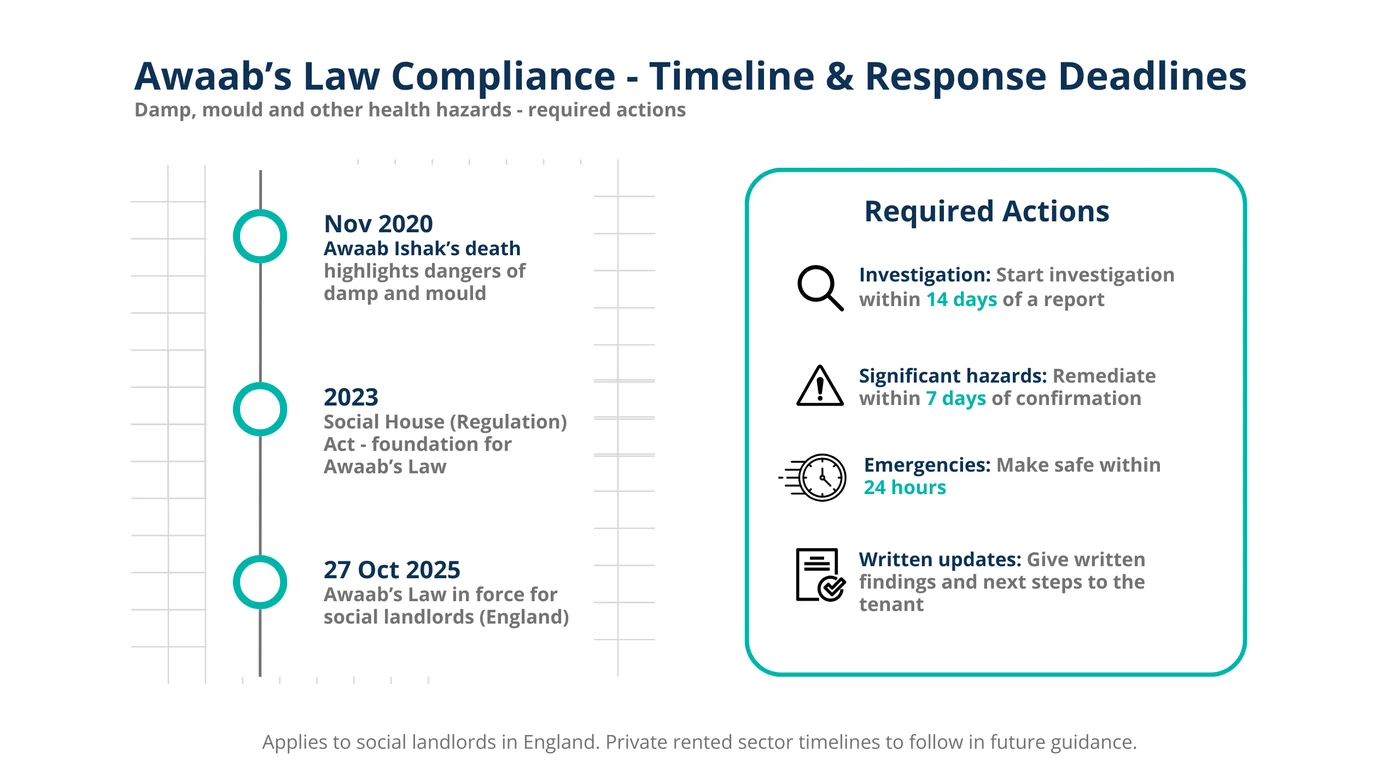
Awaab’s Law emerged from the tragic circumstances surrounding the death of two-year-old Awaab Ishak in December 2020, whose respiratory failure resulted from prolonged exposure to severe mould conditions in social housing. The subsequent coroner’s inquiry revealed systemic failures in hazard assessment, tenant communication, and remediation responses that prompted fundamental legislative reform designed to prevent similar tragedies through enhanced regulatory oversight and statutory obligations for rapid hazard remediation.
The Social Housing (Regulation) Act 2023 provides the statutory framework for Awaab’s Law implementation, establishing new regulatory powers for the Regulator of Social Housing and creating specific legal obligations for registered providers regarding damp and mould hazard management. The legislation recognises that existing reactive approaches to property maintenance prove inadequate for protecting tenant health, particularly for vulnerable populations including children, elderly residents, and individuals with compromised immune systems who face disproportionate health risks from mould exposure.
Key Legislative Changes
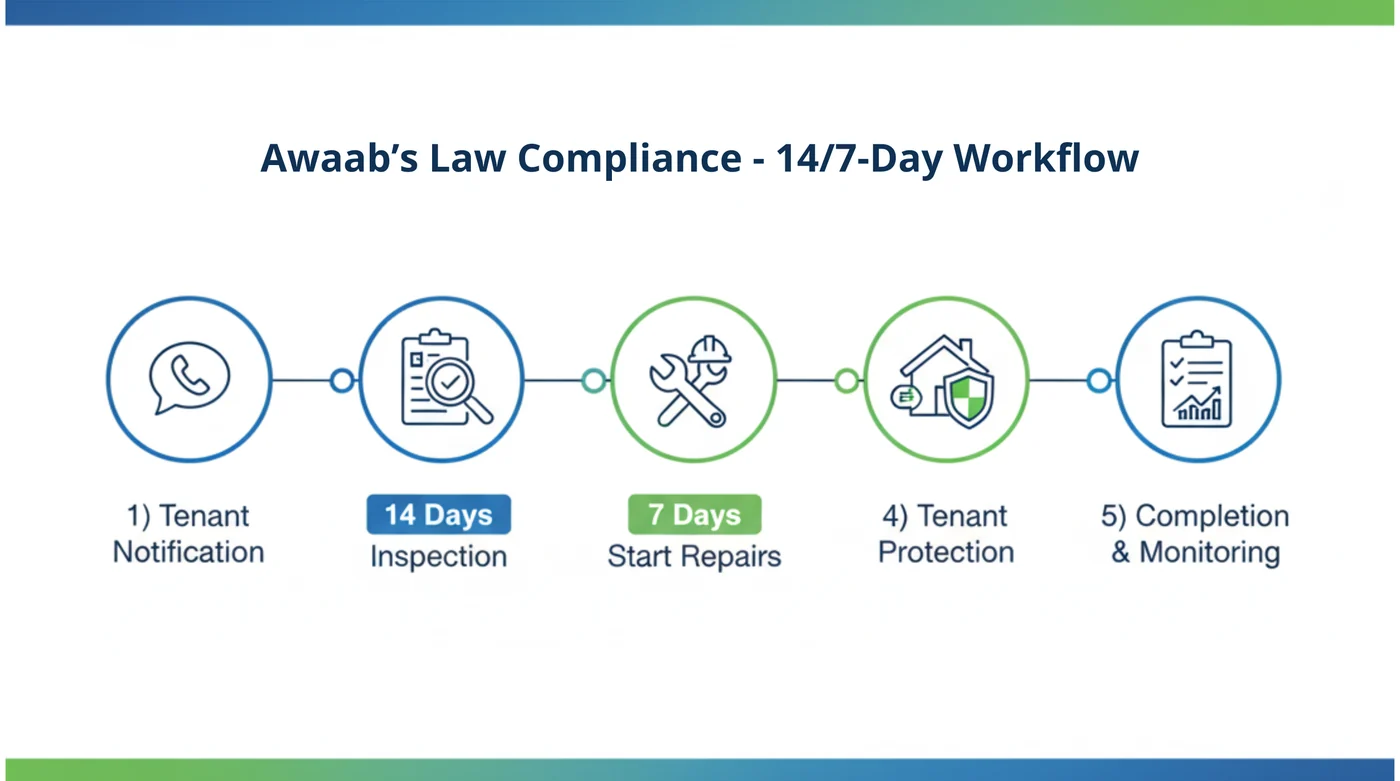
Awaab’s Law introduces statutory timeframes for hazard assessment (14 days), remediation commencement (7 days), and completion requirements, backed by regulatory enforcement powers including financial penalties and potential management transfer for non-compliant providers.
Statutory Obligations and Compliance Timeframes
The core statutory obligations under Awaab’s Law establish strict timeframes that replace previous discretionary approaches to damp and mould management with legally binding requirements. Social housing providers must complete initial hazard assessments within 14 days of receiving tenant notifications about potential damp and mould problems, utilising Housing Health and Safety Rating System (HHSRS) methodology to determine whether conditions constitute Category 1 or Category 2 hazards requiring immediate intervention.
Following hazard identification, providers must commence remedial action within 7 days for Category 1 hazards, with completion timeframes determined by hazard severity and complexity of required works. The legislation recognises that effective remediation may require extensive building works, but mandates that temporary measures must be implemented to protect tenant health during works completion, including provision of alternative accommodation where continued occupation poses health risks. Documentation requirements include detailed records of assessment findings, remediation plans, works progress, and verification of completion effectiveness.
| Compliance Stage | Timeframe | Required Actions | Documentation |
|---|---|---|---|
| Initial Assessment | 14 days | HHSRS hazard assessment | Assessment report, risk rating |
| Category 1 Response | 7 days | Remediation commencement | Action plan, contractor appointment |
| Tenant Protection | Immediate | Health protection measures | Decanting records, interim measures |
| Works Completion | Reasonable period | Full remediation | Completion certificates, verification |
Housing Health and Safety Rating System Implementation
Awaab’s Law compliance requires comprehensive understanding of the Housing Health and Safety Rating System (HHSRS) methodology, which provides the framework for assessing damp and mould hazards and determining appropriate response levels. The HHSRS evaluates 29 different hazards that can affect residential properties, with damp and mould constituting one of the most serious categories due to potential for severe health impacts, particularly for vulnerable occupants including children, elderly residents, and individuals with respiratory conditions.
Category 1 hazards under HHSRS methodology represent serious risks requiring immediate remediation, whilst Category 2 hazards indicate lesser risks that nonetheless require timely intervention to prevent escalation to Category 1 status. The assessment process considers multiple factors including extent of mould growth, affected property areas, occupant vulnerability, and potential health impacts, with trained assessors utilising standardised scoring methods to ensure consistent hazard evaluation across different properties and circumstances. Understanding HHSRS methodology enables property operators to conduct preliminary risk assessments and prioritise resources effectively whilst ensuring compliance with statutory obligations.
HHSRS Assessment Process:
- Hazard Identification: Visual inspection and environmental assessment
- Risk Evaluation: Occupant vulnerability and exposure assessment
- Category Classification: Scoring methodology application
- Action Determination: Required intervention level identification
- Documentation: Formal assessment record completion
Practical Implementation Strategies
Effective Awaab’s Law compliance requires systematic operational changes encompassing staff training, process standardisation, contractor management, and technology integration to ensure consistent delivery of statutory obligations across property portfolios. Successful implementation begins with comprehensive staff training programmes covering hazard recognition, assessment methodology, documentation requirements, and emergency response procedures, ensuring all personnel understand their roles in maintaining regulatory compliance and protecting tenant health.
Technology solutions play increasingly important roles in compliance management, with digital platforms enabling automated notification systems, workflow management, progress tracking, and documentation storage to support audit requirements and regulatory reporting. Integration with existing property management systems enables seamless case management whilst providing management information for performance monitoring and continuous improvement initiatives. Contractor framework agreements should specify Awaab’s Law compliance requirements, including response timeframes, quality standards, and documentation obligations to ensure external service providers support rather than compromise compliance objectives.
Implementation Success Factors:
- Staff Competency: Comprehensive training on HHSRS assessment methodology
- Process Standardisation: Documented procedures for consistent compliance delivery
- Technology Integration: Digital platforms supporting workflow management
- Contractor Management: Framework agreements specifying compliance requirements
- Performance Monitoring: KPIs tracking compliance effectiveness and outcomes
Regulatory Enforcement and Consequences
The Regulator of Social Housing possesses extensive enforcement powers under Awaab’s Law, including ability to impose financial penalties, issue statutory notices requiring specific actions, and in extreme cases, transfer management responsibilities to alternative providers. Financial penalties can reach significant levels proportionate to provider size and severity of non-compliance, with repeat offenders facing escalating enforcement action that can ultimately threaten continued registration and ability to operate social housing stock.
Beyond financial penalties, regulatory enforcement can result in reputational damage affecting provider ability to secure funding, partnerships, and development opportunities essential for long-term viability. Public reporting of non-compliance through regulatory judgment publications creates transparency that influences tenant confidence and stakeholder relationships, emphasising the importance of proactive compliance management rather than reactive responses to regulatory intervention. Understanding enforcement mechanisms enables property operators to implement robust compliance frameworks that prevent regulatory issues whilst demonstrating commitment to tenant welfare and regulatory excellence.
Enforcement Escalation Process:
Regulatory intervention typically follows escalating stages: informal engagement, formal notices, financial penalties, intensive regulation, and ultimate management transfer. Early intervention through proactive compliance prevents escalation to more serious enforcement measures.
Impact on BTR and PBSA Operators
Although Awaab’s Law directly applies only to registered social housing providers, the legislation creates significant implications for Build-to-Rent (BTR) operators and Purpose-Built Student Accommodation (PBSA) managers through duty of care obligations, sector standard expectations, and potential future regulatory extension. The heightened focus on tenant health protection establishes new industry benchmarks that informed property operators increasingly adopt voluntarily to demonstrate commitment to tenant welfare and risk management excellence.
BTR and PBSA operators implementing Awaab’s Law equivalent standards gain competitive advantages through enhanced tenant satisfaction, reduced liability exposure, and improved asset protection through proactive maintenance approaches. Insurance providers increasingly recognise superior risk management practices when determining coverage terms and premium levels, whilst institutional investors place growing emphasis on ESG compliance that includes tenant health protection measures. Understanding Awaab’s Law requirements enables all property operators to implement best practice standards regardless of direct regulatory coverage, as detailed in our comprehensive guide on preventing damp and mould across all rental property types.
Future Regulatory Developments and Sector Evolution
Awaab’s Law represents the initial phase of broader regulatory reform affecting the private rented sector, with government consultation processes exploring extension of similar requirements to BTR operators, PBSA managers, and traditional private landlords. The success of social housing implementation will likely influence timing and scope of broader sector application, creating incentives for proactive adoption of equivalent standards before mandatory implementation occurs.
Emerging regulatory trends emphasise prevention-focused approaches that address building performance deficiencies before health hazards develop, requiring investment in environmental monitoring, building fabric improvements, and tenant education programmes. Technology integration increasingly supports compliance management through automated systems enabling early problem identification and intervention before statutory timeframes apply. Property operators developing comprehensive understanding of Awaab’s Law requirements position themselves advantageously for future regulatory developments whilst demonstrating sector leadership in tenant health protection, as explored in our analysis of changing standards in damp and mould management.
Ready to take control of damp & mould risks in your portfolio? Discover proven tools for compliance and tenant protection.
Frequently Asked Questions
Related Resources
For comprehensive guidance on related topics, explore our additional resources:
- What Causes Damp and Mould in UK Homes? A Comprehensive Guide for Property Portfolio Operators
- The Hidden Health Risks of Damp and Mould: Essential Knowledge for Property Portfolio Operators
- Awaab’s Law: How Changing Standards Are Reshaping Property Management
- How to Prevent Damp and Mould in Rental Properties: A Complete Guide