Accurate diagnosis of moisture problems is the cornerstone of effective property portfolio management and regulatory compliance under Awaab’s Law. Misdiagnosis leads to inappropriate remedial works, recurring problems, escalating costs, and potential regulatory sanctions. For social housing providers, BTR operators, and PBSA managers, the financial implications of diagnostic errors can be catastrophic—with individual cases costing tens of thousands in failed remedial works, temporary accommodation, and legal liabilities.
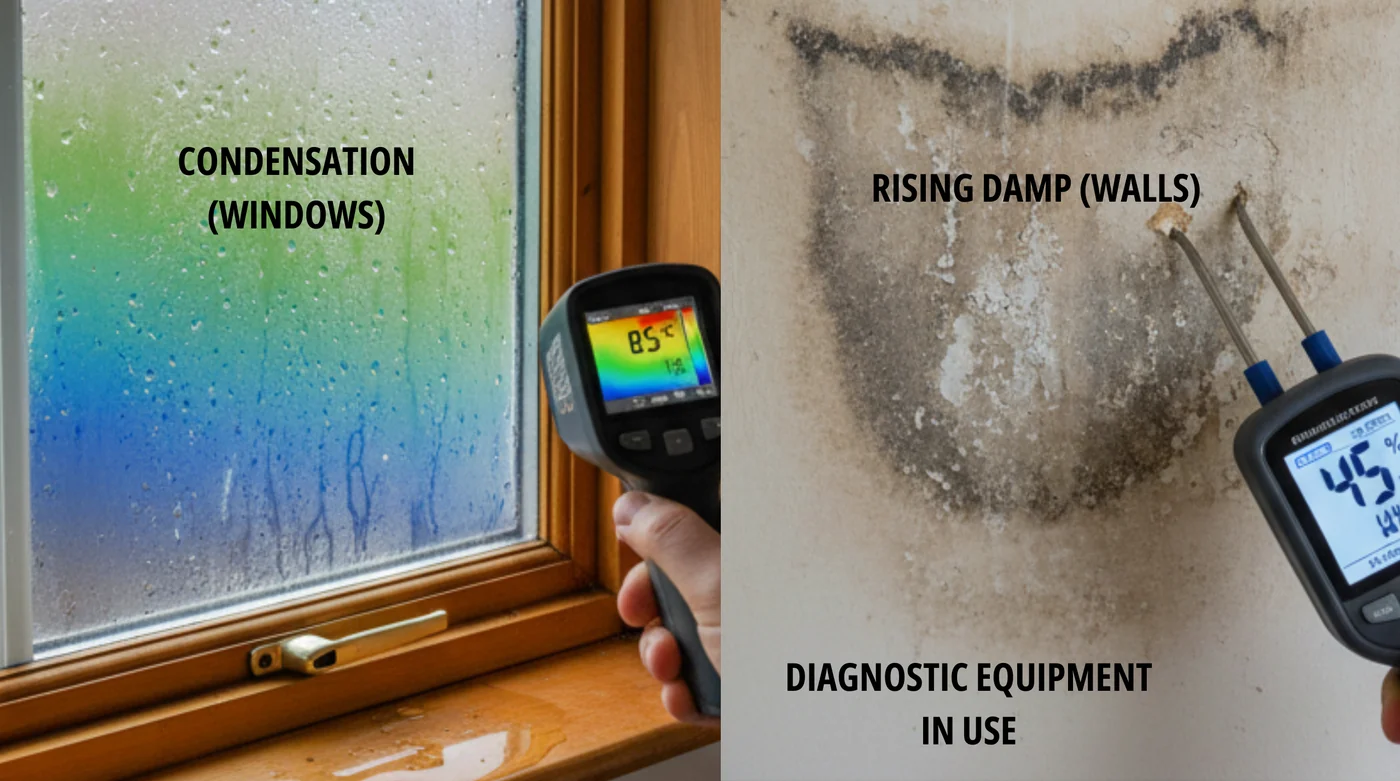
The challenge for property portfolio operators lies in the superficial similarity between different moisture problems. All can manifest as visible mould growth, musty odours, and deteriorating internal finishes. However, their underlying causes, progression patterns, and effective treatments are fundamentally different. Understanding these distinctions is not just about technical accuracy—it’s about risk management, cost control, and ensuring appropriate duty of care to residents.
Professional diagnostic capability becomes even more critical when considering the scale of operations. A property portfolio with systematic misdiagnosis problems can face thousands of properties requiring re-treatment, massive financial exposure, and regulatory intervention. Conversely, portfolios with robust diagnostic processes achieve better outcomes at lower costs while maintaining regulatory compliance and resident satisfaction.
Understanding the Fundamental Differences: Moisture Physics in Buildings
To develop effective diagnostic capabilities, property portfolio operators must understand how different moisture problems develop and behave within buildings. Each type of moisture problem follows distinct physical principles and creates characteristic patterns that enable accurate identification when properly understood.
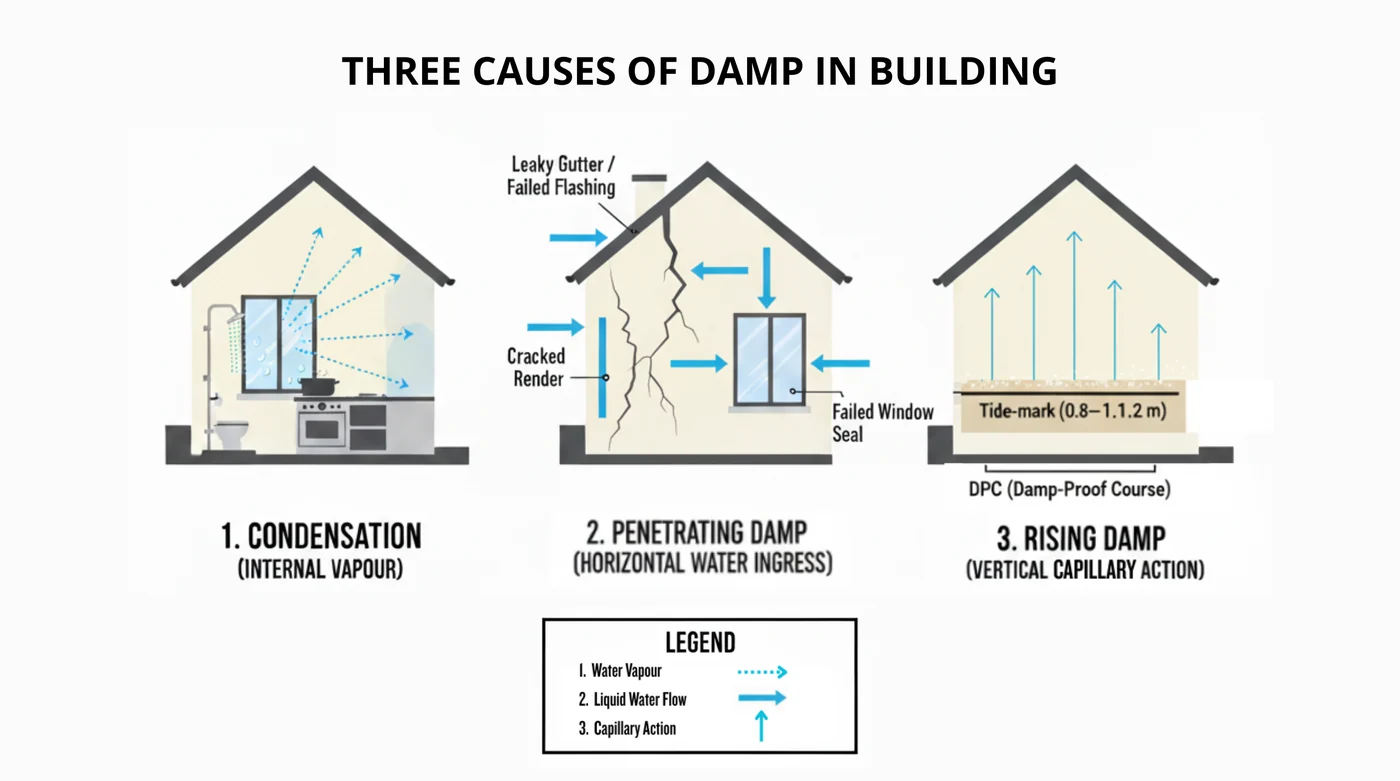
Condensation occurs when water vapour in the air reaches saturation point and transforms into liquid water. This happens when warm, moisture-laden air contacts surfaces below the dew point temperature, or when air temperature drops while moisture content remains constant. The key insight for property managers is that condensation is an indoor air quality and building physics problem—it indicates that the building’s moisture balance is inadequate for the occupancy pattern and environmental conditions.
Penetrating damp, by contrast, involves liquid water entering the building through the external envelope. This occurs when the building’s weatherproofing systems fail or become overwhelmed by external weather conditions. Understanding penetrating damp requires appreciation of how water moves under pressure through building materials, following paths of least resistance through cracks, gaps, and porous materials.
Rising damp represents the third major category, involving ground moisture moving upward through building materials via capillary action. This phenomenon occurs when the building’s damp-proof course is absent, defective, or bypassed, allowing ground moisture to wick up through foundations and walls. Rising damp is particularly common in older UK properties and requires understanding of both building construction history and groundwater conditions.
Professional Moisture Assessment and Monitoring
Accurate moisture diagnosis is fundamental to effective property portfolio management, but implementing consistent diagnostic capabilities across diverse property types and locations presents significant challenges. Modern portfolio management requires systematic approaches that combine professional expertise, appropriate technology, and robust quality assurance processes.
Advanced moisture management systems integrate continuous environmental monitoring, predictive analytics, and professional diagnostic capabilities to identify problems early and ensure appropriate intervention strategies. This proactive approach not only ensures better outcomes for residents but also optimises maintenance costs and regulatory compliance across entire property portfolios.
Environmental Conditions and Moisture Behaviour
The behaviour of each moisture type varies significantly with environmental conditions, occupancy patterns, and seasonal changes. Professional diagnosticians understand these patterns and use them to differentiate between moisture types and predict problem development.
Condensation problems typically worsen during cold weather when the differential between internal and external temperatures increases. They often correlate with changes in occupancy patterns—increased heating, cooking activities, or drying laundry indoors. Condensation shows daily and seasonal variation patterns that follow temperature and humidity cycles. It frequently appears first on the coldest surfaces—north-facing walls, window frames, and areas with thermal bridges.
Penetrating damp shows a different pattern, directly correlating with external weather conditions. Problems appear during or shortly after periods of wind-driven rain, particularly when wind direction drives moisture against specific building elevations. The relationship between external weather and internal moisture problems provides crucial diagnostic information—penetrating damp follows weather patterns while condensation follows occupancy and heating patterns.
Professional Diagnostic Techniques and Tools
Effective diagnosis requires systematic assessment using appropriate tools and methodologies. Professional property assessment goes beyond visual inspection to include quantitative measurement, environmental monitoring, and understanding of building construction and occupancy patterns.
Moisture content measurement forms the foundation of professional diagnosis. Electronic moisture meters provide instant readings of moisture levels in different materials, but interpretation requires understanding of background moisture levels, material properties, and measurement limitations. Capacitance meters work well for general screening but can be affected by surface salts and material density. Resistance meters require probe insertion but provide more reliable readings for most building materials.
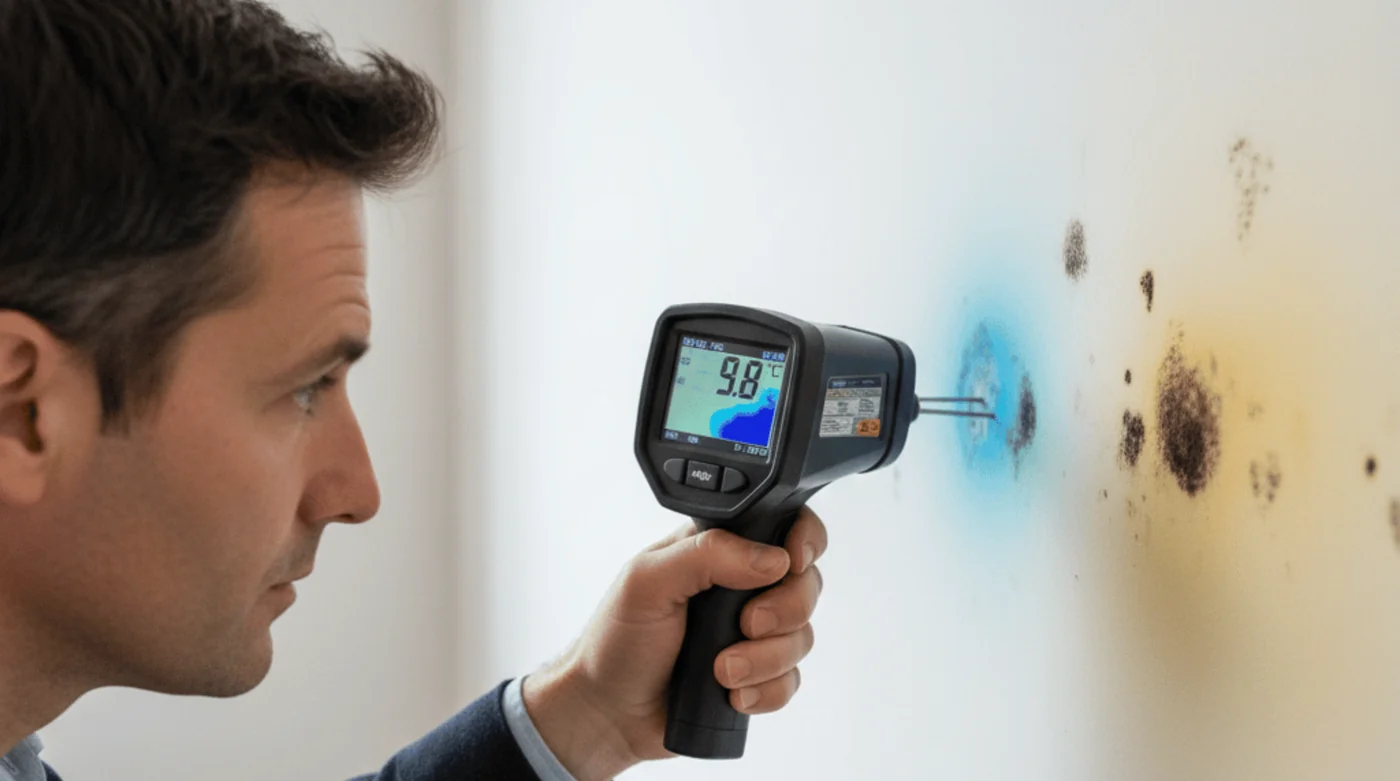
Thermal imaging has revolutionised moisture diagnosis by revealing temperature patterns invisible to visual inspection. Thermal cameras identify thermal bridges where condensation is likely to occur, detect areas of moisture evaporation that indicate damp problems, and reveal construction details that affect moisture behaviour. Professional thermal survey requires understanding of when to survey (ideally with temperature differential), how environmental conditions affect results, and interpretation of thermal patterns in relation to moisture problems.
| Diagnostic Tool | Application | Limitations | Professional Use |
|---|---|---|---|
| Electronic Moisture Meters | Quantify moisture content in materials | Surface contamination affects readings | Essential for establishing moisture extent |
| Thermal Imaging Cameras | Identify temperature patterns, thermal bridges | Requires temperature differential, expert interpretation | Critical for understanding building performance |
| Hygrometers | Measure relative humidity, dew point | Point-in-time readings, calibration required | Establish environmental conditions |
| Endoscopic Inspection | Visual inspection within wall cavities | Limited access points, interpretation needed | Investigate structural moisture paths |
Environmental Monitoring and Assessment
Understanding environmental conditions is crucial for accurate diagnosis. Professional assessment includes measurement of relative humidity, air temperature, surface temperatures, and ventilation rates. These measurements must be interpreted in context of occupancy patterns, heating systems operation, and external weather conditions.
Relative humidity measurement provides insight into condensation risk and the building’s moisture balance. Professional assessment requires understanding that relative humidity varies with temperature—50% RH at 20°C becomes nearly 100% RH if temperature drops to 10°C without moisture removal. Surface temperature measurement identifies areas where condensation is likely to occur, typically surfaces more than 2-3°C below air temperature in high-humidity conditions.
Condensation: Identification and Characterisation
Condensation problems require careful characterisation to develop effective solutions. Understanding the specific conditions that create condensation in each property enables targeted interventions that address root causes rather than symptoms. For property portfolio operators, this precision is essential for cost-effective problem resolution and preventing recurrence.
Condensation typically manifests in predictable locations and patterns. It appears first on the coldest surfaces within the property, creating a hierarchy of risk areas. Single-glazed windows and frames represent the highest risk, followed by external walls without insulation, areas around thermal bridges, and unheated or irregularly heated rooms. The pattern of condensation occurrence provides diagnostic information—if moisture problems correlate with heating patterns and appear on predictably cold surfaces, condensation is the most likely cause.
The timing of condensation problems offers crucial diagnostic information. Problems that worsen during cold weather, appear during periods of high internal moisture production, or correlate with changes in heating patterns suggest condensation rather than structural moisture ingress. Condensation problems often show daily variation—worse in mornings after overnight temperature drops, or after high moisture-producing activities like cooking and bathing.
- Moisture appears on predictably cold surfaces first
- Problems correlate with weather patterns (worse in cold weather)
- Daily variation following temperature and humidity cycles
- Can be temporarily removed by wiping or increased ventilation
- Often associated with lifestyle factors (cooking, drying clothes, heating patterns)
Surface Condensation vs Interstitial Condensation
Professional diagnosis must distinguish between surface condensation and interstitial condensation, as they require different solutions. Surface condensation occurs on visible internal surfaces and is relatively straightforward to identify and address. Interstitial condensation occurs within the building fabric—inside wall cavities, roof spaces, or within building materials—and can cause serious structural damage while remaining hidden from view.
Interstitial condensation is particularly problematic in modern energy-efficient buildings or older buildings that have been retrofit with insulation. Warm, moist internal air can penetrate into wall cavities where it cools and condenses, potentially causing timber decay, metal corrosion, and insulation deterioration. Identifying interstitial condensation requires understanding of vapour pressure differentials, dewpoint calculations, and building construction details.
Penetrating Damp: Recognition and Assessment
Penetrating damp presents distinct challenges for property portfolio operators due to the variety of potential ingress routes and the relationship between external weather conditions and internal moisture problems. Accurate identification requires understanding of building construction, weather patterns, and the physics of water movement through building materials.
Penetrating damp shows clear correlation with external weather conditions, particularly periods of wind-driven rain. The direction of weather systems becomes relevant—problems that appear after south-westerly storms suggest different causes than those appearing after easterly weather. Understanding local microclimate effects is important, as some building elevations may be more exposed to prevailing weather patterns than others.
The location and pattern of penetrating damp provides diagnostic information about ingress routes. Damp patches that appear at specific levels often indicate problems with external features—window sills, copings, or roof details. Penetrating damp frequently follows predictable paths through the building structure, appearing at junctions between different materials or where construction details create potential ingress routes.
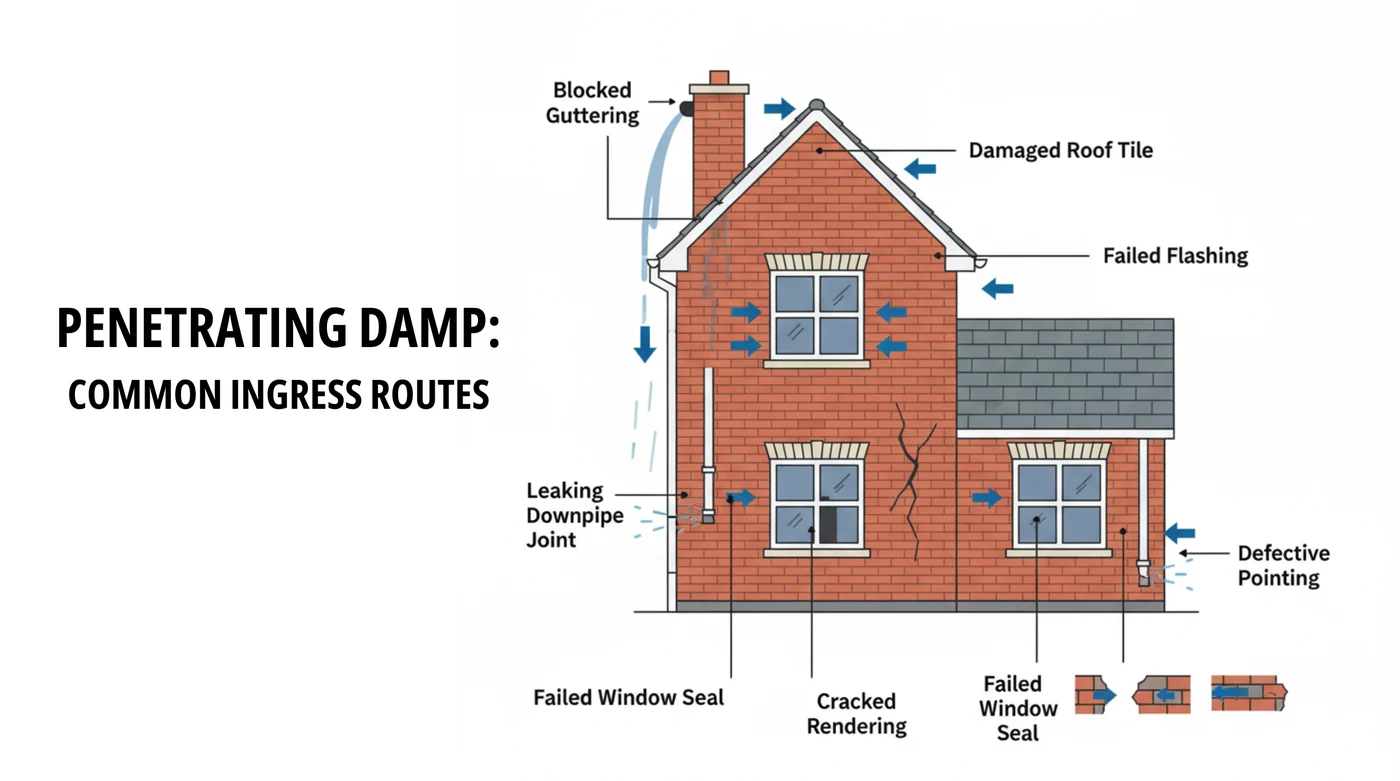
Common Penetrating Damp Sources
Systematic assessment of penetrating damp requires understanding of typical failure modes in building construction. Roof-level problems are common sources—blocked or damaged guttering, missing roof tiles, failed flashings around chimneys or roof penetrations. Wall-level ingress often occurs through failed pointing, cracked render, defective window and door seals, or cavity wall construction defects.
Ground-level penetrating damp can result from poor drainage, failed damp-proof courses, or landscaping that bridges damp-proof membranes. Understanding the age and construction type of properties helps predict likely failure modes—Victorian properties commonly experience pointing failure and roof detail problems, while 1960s system-built properties may have panel joint failures or cavity insulation problems.
Rising Damp: Identification and Limitations
Rising damp diagnosis requires careful assessment as it’s often confused with other moisture problems, leading to inappropriate and expensive treatment programs. True rising damp is less common than often claimed, but when present, it requires specific treatment approaches that differ fundamentally from condensation or penetrating damp solutions.
Genuine rising damp shows characteristic height limitations—typically affecting ground floor walls up to 1-1.5 metres above floor level. This height limit reflects the balance between capillary forces drawing moisture upward and evaporation removing it from the wall surface. Rising damp creates distinctive salt deposits as ground moisture contains dissolved minerals that concentrate as water evaporates from wall surfaces.
The seasonal pattern of rising damp differs from other moisture problems. It often worsens during winter months when evaporation rates are lower, allowing moisture to rise higher in walls. However, unlike condensation, rising damp doesn’t correlate with occupancy patterns or heating cycles—it reflects ground moisture conditions and seasonal groundwater variations.
| Moisture Type | Primary Indicators | Pattern Characteristics | Environmental Correlation |
|---|---|---|---|
| Condensation | Cold surfaces, wiping removes moisture | Daily/seasonal variation, thermal bridge areas | Internal temperature/humidity cycles |
| Penetrating Damp | Weather correlation, ingress routes visible | Specific elevations, construction junctions | External weather events |
| Rising Damp | Height limitation, salt deposits present | Ground floor walls, consistent across property | Ground moisture/seasonal groundwater |
False Rising Damp Diagnosis
Many cases diagnosed as rising damp actually result from other causes—penetrating damp at ground level, plumbing leaks, or condensation in unheated ground floor rooms. Professional assessment requires elimination of other potential causes before confirming rising damp diagnosis. This is crucial because rising damp treatments (injection damp-proof courses, replastering with special systems) are expensive and ineffective for other moisture problems.
Signs that suggest alternative causes to rising damp include moisture above typical rising damp heights, absence of salt deposits, correlation with weather or occupancy patterns, or recent ground works that might affect drainage. Professional diagnosis often requires extended monitoring to distinguish between genuine rising damp and other moisture sources.
Understanding Root Causes
Before proceeding with diagnosis, review our comprehensive guide on What Causes Damp and Mould in UK Homes to understand the fundamental factors behind moisture problems.
Health Risk Management
Understand why accurate diagnosis is critical for resident health with our guide on The Hidden Health Risks of Damp and Mould.
Legal Compliance Requirements
Ensure your diagnostic processes meet regulatory requirements with our Awaab’s Law Explained: Essential Compliance Guide.
Developing Portfolio-Wide Diagnostic Capabilities
For property portfolio operators, developing systematic diagnostic capabilities requires more than understanding individual moisture problems. It requires processes, training, technology systems, and quality assurance that ensure consistent, accurate assessment across diverse property types and geographical locations.
Professional diagnostic capability starts with staff training and competence development. Property managers, maintenance teams, and inspection staff need to understand moisture problem recognition, appropriate use of diagnostic equipment, and when to escalate for specialist assessment. This training must be regularly updated as building construction methods evolve and new diagnostic technologies become available.
Technology systems play an increasingly important role in portfolio-wide moisture management. Digital moisture meters with data logging capabilities enable trend analysis and quality assurance. Thermal imaging surveys can be standardised and compared across properties and time periods. Environmental monitoring systems provide objective data about building performance and moisture risk factors.
Quality Assurance in Moisture Diagnosis
Implementing robust diagnostic processes across property portfolios requires systematic quality assurance, regular calibration of equipment, and independent verification of diagnosis accuracy. This approach not only ensures better outcomes for residents but also provides defensible evidence for regulatory compliance and insurance purposes.
Ready to take control of damp & mould risks in your portfolio? Discover proven tools for compliance and tenant protection.
Frequently Asked Questions
Key differences: Condensation appears on predictably cold surfaces, can be wiped away, correlates with internal activities and cold weather. Penetrating damp appears after rain, follows specific ingress routes, creates persistent damp patches with potential staining or tide marks, and often shows salt deposits.
Essential kit includes: electronic moisture meter (capacitance type for screening), digital thermometer/hygrometer for environmental conditions, thermal imaging camera or infrared thermometer for surface temperatures, and basic inspection tools (torch, probes). Professional assessment may require specialist equipment and expertise.
Specialist assessment is needed for: complex or recurring problems, suspected structural moisture issues, properties with multiple moisture types, high-value remedial works, regulatory compliance requirements, or when initial diagnosis is unclear. Early specialist involvement often saves money long-term.
Yes, properties frequently have multiple moisture issues simultaneously. For example, penetrating damp through the roof combined with condensation in poorly heated rooms, or rising damp at ground level with condensation at upper levels. Each problem requires specific treatment approaches.
Implement standardised diagnostic procedures, regular equipment calibration, staff training programs, quality assurance reviews, and specialist verification for complex cases. Consider central diagnostic support services and consistent documentation systems across all properties.
The most common error is misdiagnosing condensation as structural damp (or vice versa), leading to inappropriate treatment. Surface moisture doesn’t always indicate the underlying cause. Always consider occupancy patterns, building construction, weather correlation, and use appropriate diagnostic equipment for accurate assessment.
Thermal bridges are areas with poor insulation that become cold, creating condensation risk. Common locations include window frames, wall-floor junctions, and structural elements. Thermal imaging reveals these areas clearly. Understanding thermal bridge locations helps predict condensation problems and target insulation improvements.
Always establish accurate diagnosis before implementing solutions. Emergency action may be needed for health risks (immediate ventilation, mould removal), but permanent solutions require understanding root causes. Treating symptoms without addressing causes leads to recurring problems and wasted resources.
Related Resources
For comprehensive guidance on related topics, explore our additional resources:
- What Causes Damp and Mould in UK Homes? A Comprehensive Guide for Property Portfolio Operators
- Effective Communication with Tenants About Damp and Mould Risks
- Awaab’s Law Explained: Essential Compliance Guide for Property Portfolio Operators
- How to Prevent Damp and Mould in Rental Properties: A Complete Guide